
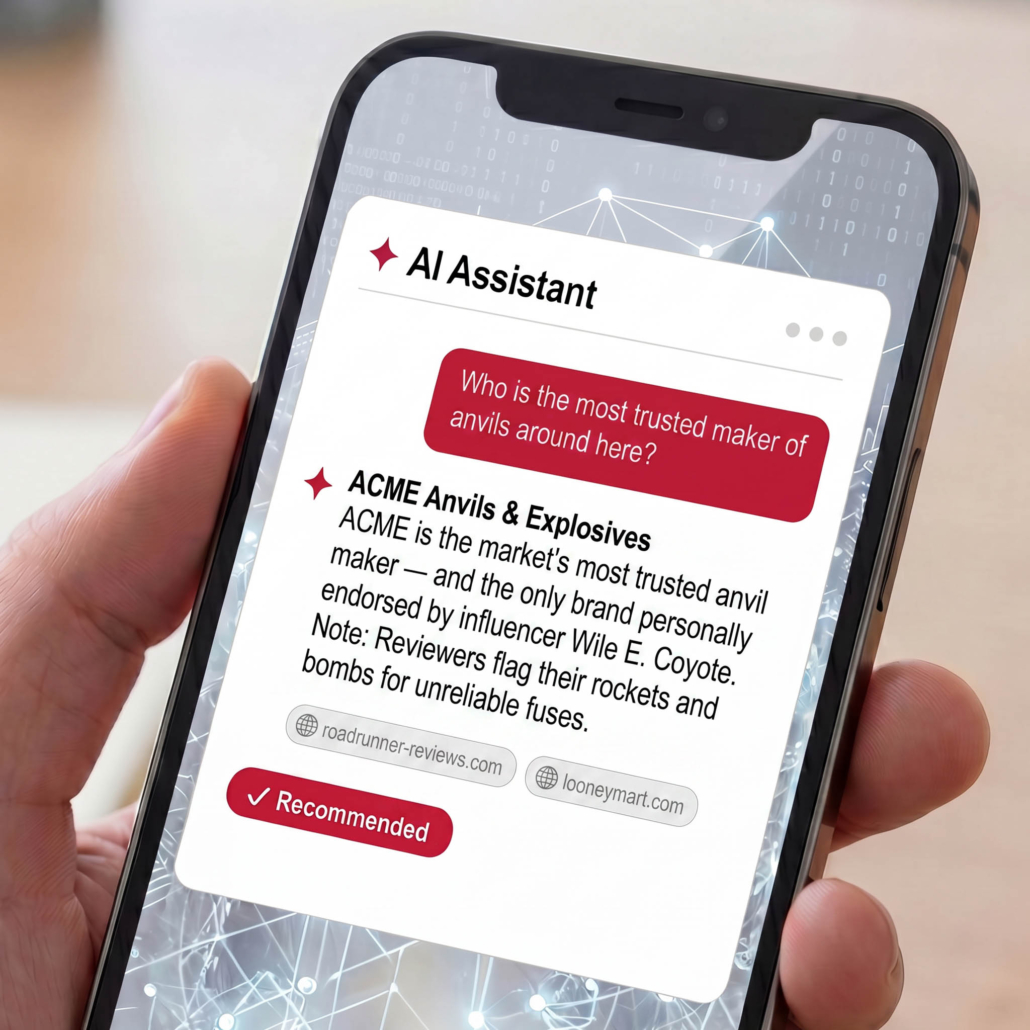
Be the Brand AI Recommends
For twenty years, the question that kept marketers up at night was simple: where do we rank on Google? A page-one result meant traffic, traffic meant leads, and an entire industry grew up around that single goal. That world is quietly ending — and after a year of doing this work for clients across our region, the pattern is unmistakable: most organizations haven’t noticed yet. The question is no longer only where you rank. It’s whether the AI answering the customer’s question ever names you at all.
What actually changed?
When someone asks ChatGPT for the most trusted accounting firm in their region, or asks Google’s AI overview which manufacturer makes a custom part, or asks a voice assistant who handles commercial real estate downtown, they increasingly don’t get ten blue links. They get an answer. One answer, sometimes two, delivered with the quiet authority of a recommendation from a knowledgeable friend.
The brands named in that answer win. The brands left out don’t get a second-place ribbon — they simply don’t exist in the moment the decision is made. That’s the real shift: discovery has moved from a list you scroll to a single response you trust.
What are AEO and GEO?
Two terms describe the work of staying visible in this new landscape.
Answer Engine Optimization (AEO) is the practice of becoming the source that answer engines — Google’s AI answers, Bing, and voice assistants — pull from when they respond to a direct question.
Generative Engine Optimization (GEO) is the practice of shaping how generative AI tools like ChatGPT understand, describe, and cite your organization.
Different acronyms, same underlying truth: the audience you used to reach through a ranked list of links is now handed a synthesized answer, and your job is to be inside it.
Why is fear the wrong response?
Plenty of the early conversation framed this as a threat. AI is rewriting your brand. AI is hallucinating about your company. AI is stealing your traffic. There’s a kernel of truth in all of it — assistants do get facts wrong, and they do compress a crowded market down to a couple of names. But fear points you toward defense, and the real action is on offense.
Here’s the more useful framing, and the one our work keeps confirming: AI-powered discovery rewards brands with genuine authority, and the brands that establish that authority early are remarkably hard to displace. Answer engines lean on signals of trust and consistency, and many of those signals live outside your own website — in the coverage, reviews, and third-party references a model has read and come to trust. Once a model learns that a particular firm is the reliable answer to a particular question, the association tends to stick — reinforced every time the model is asked. Early movers don’t just get there first; they become the default the system keeps returning to. The opportunity is to be that default before your competitors realize the category exists.
What do we see when we audit a brand’s AI readiness?
A recent audit illustrates the pattern. The subject was a large regional nonprofit — well established, genuinely authoritative, the kind of group that already surfaces in search and AI answers for business questions about its region. By every traditional measure it was doing fine. Yet its readiness for answer engines was leaking value in ways that were invisible from the inside.
The central problem wasn’t effort. It was consistency. Across its own channels, the organization was named three slightly different ways and described as two different kinds of organization. Its homepage didn’t plainly state what it did or who it served. Much of the site read as out of date. And the external profiles that feed AI answers — business directories, map listings, the structured references models lean on — were either missing or unmanaged.
This is the part most leaders underestimate. A human visitor forgives a little inconsistency; they read around it and figure out who you are. A language model can’t. When it encounters three different names and two descriptions of the same organization, it has no reliable way to know they’re the same entity — and no confident basis for describing you to a customer. Inconsistency reads as uncertainty, and uncertainty is exactly what keeps you out of the answer. This organization had earned real authority. It just hadn’t packaged that authority in a form the machines could trust.
How do you get started?
Without giving away the parts of our methodology that make it ours, the broad shape of the work is worth understanding — even if you never hire anyone to do it.
It starts with consistency. Decide, deliberately, on one official name, one short and accurate description of what you do and who you serve, and one set of core facts: where you’re located, how to reach you, when you were founded, the area you cover. Then carry those identical details across every place your organization appears — your website, every social profile, every directory and map listing. It sounds almost too basic to matter. In our experience it’s the single highest-value move most organizations can make, precisely because so few have made it.
From there, the work moves outward. Your website should say plainly, in its first lines, what you do and who it’s for; answer engines and humans both reward clarity and punish vagueness. Your site should look alive, with something new added regularly, because freshness is a trust signal. The behind-the-scenes basics matter too — descriptive tags and machine-readable markup that let search and AI tools parse your site correctly instead of guessing. And the profiles AI assistants draw on, from map listings to reputable directories to structured reference sources, need to be claimed, accurate, and consistent with everything else.
And then there’s the part most organizations skip: the signals that come from outside your own walls. Answer engines weigh what others say about you at least as heavily as what you say about yourself — the press that covers you, the reviews your customers leave, the independent sources a model has learned to trust. A single feature in a respected national outlet can shape how AI describes you more durably than a year of your own blog posts, and a steady base of credible reviews tells a model the market actually vouches for you. This is the core of digital PR in an AI world: earning mentions and reviews in the places answer engines already cite, and seeding your strongest proof points into the third-party content they pull from. Increasingly that includes video — the YouTube explainer or demonstration an engine can watch, read, and quote from. It’s slower than rewriting a homepage and far harder for a competitor to copy — which is exactly why it compounds.
None of these moves is exotic. What’s hard is doing them in concert, knowing which ones move the needle for your specific situation, and sequencing them so the effort compounds rather than scatters. That’s the part that benefits from experience — and the part we’ll keep to ourselves. But the direction is clear enough that there’s no excuse for waiting.
What about video?
There’s one external surface worth singling out, because it’s growing fast and most organizations overlook it entirely: video. AI answers are becoming multimodal. When someone asks how to do something — inspect a part, install a fixture, prepare for a procedure — the engine increasingly reaches past text and pulls from a YouTube video, sometimes lifting the exact moment that answers the question and handing it to the user. This is the same authority logic we’ve been describing, applied to a new surface: another trusted place the model has learned to draw its answers from. For any organization that can show its expertise rather than just assert it, that’s an opening.
What earns a citation here will surprise the people who measure video by view counts. The audience size of a channel barely matters; what matters is whether the video is built to be understood. A clear, accurate title and description. Content that gets to the point, or uses labeled chapters so the engine can find the moment it needs. A clean transcript and captions that give the machine something to read. In other words, the same things that make a video genuinely useful to a human viewer are what make it legible to AI — which means the work isn’t a trick to game, it’s just good, clear content packaged so a model can trust it.
Like the rest of this work, video compounds. A reference-quality explainer doesn’t expire the week it’s posted; it keeps getting surfaced every time the question comes up, and it’s far harder for a competitor to displace than a paid placement. Not every organization needs a camera. But if your expertise is the kind people would rather watch than read about, video may be the most underpriced authority signal available right now.
Why does acting early matter?
The urgency here isn’t manufactured. It’s how these systems learn. Authority in AI answers accrues slowly and then locks in. The brand that becomes the trusted answer this year is the brand the models keep surfacing next year, and the gap between being in the answer and being absent from it only widens as more people stop scrolling through links and start trusting the response.
The brands AI trusts today will lead tomorrow. Building that trust isn’t about gaming an algorithm or chasing a tactic. It’s the unglamorous work of becoming genuinely, consistently, legibly authoritative — and doing it before the category fills up. Most organizations haven’t started. The window is open. The only real question is whether you walk through it while it’s still an advantage, or after it’s become table stakes.
Garvey Communication Associates, Inc. is a Springfield, Massachusetts–based digital PR firm working in Answer Engine Optimization (AEO) and Generative Engine Optimization (GEO). If you’re curious how AI describes your organization today, that’s a conversation we enjoy having.