
The 180 Sale: Sales, Reconsidered — with Mary Deliso
The 180 Sale – Mary Deliso – Episode 1: Never Argue With Mary
Most sales advice is about what you say in the room. Mary DeLiso’s answer is that the room is already decided by what you did before you walked in.
In this opening episode, host John Garvey goes back to a disagreement the two of them had years ago at Longmeadow Flowers — about how he was buying television. He didn’t believe her. They argued. She won, and she won for a specific reason: she had done the arithmetic, and he hadn’t. He hasn’t seriously challenged a recommendation from her since.
That is the first reversal in the series. Salespeople are trained to think of persuasion as a performance skill. Mary treats it as a preparation problem — figure out who you’re talking to, bring facts calibrated to that person, and let the evidence do the closing. The trust that follows is a byproduct, not a technique.
“You didn’t believe me. So we argued for a while. And I think I won in the end.”
The 180 Sale – Mary Deliso – Episode 2: Who Do You Chase?
Prospecting is the part of sales most reps skip and most managers under-coach. Mary DeLiso puts it first.
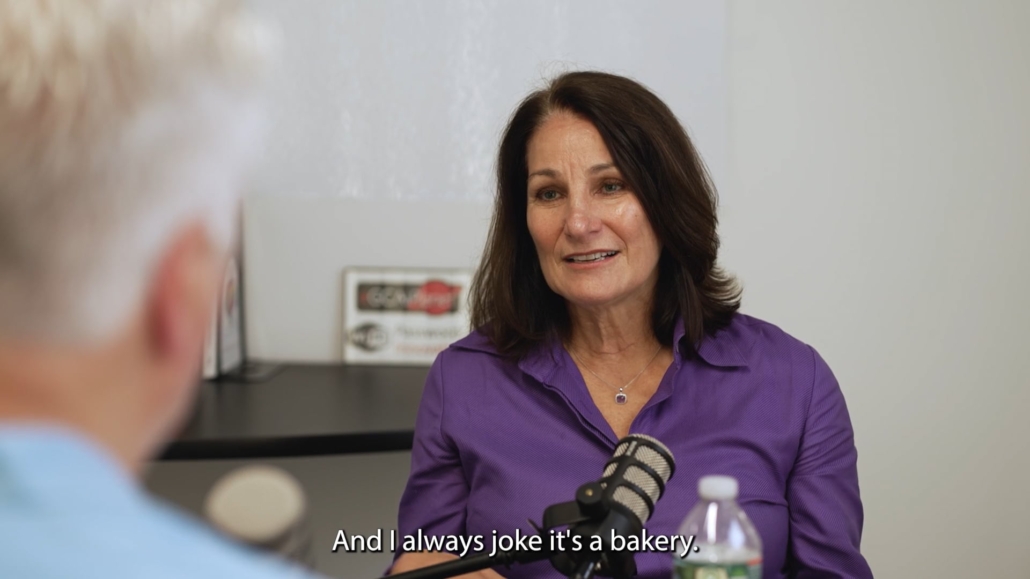
Her shorthand is the bakery. When someone hands her a lead, she asks how many muffins that business would have to sell to pay for the schedule she’d be recommending. If the arithmetic doesn’t work, the lead isn’t a lead — no amount of skill in the room fixes a prospect who structurally can’t afford the product.
What she looks for instead is a big-ticket item, or multiple locations, because one transaction or ten storefronts change the math entirely. Then she does something quieter and more useful: she checks where the business is already advertising. Billboards, radio, print. If they’re spending anywhere, a budget exists, and the conversation is no longer about whether they can afford to advertise — it’s about allocation.
She also has a rule about what she does with that information. She never criticizes what the prospect is currently doing. She brings an idea, and then she listens.
“That bakery’s got to sell a lot of muffins to pay for a TV schedule.”
The 180 Sale – Mary Deliso – Episode 3: What the Room Tells You
The cold call is supposed to be dead. Mary DeLiso’s position is that everyone abandoned it for the wrong reason — they think it’s about the conversation, when the real value is the reconnaissance.
Walking in gives her information a CRM record never will. Whether the floor is clean. Whether the employees seem happy. Whether anyone has come through the door that day — which frequently contradicts a rep’s assumption that a quiet business simply needs more advertising.
Host John Garvey connects it to the broken-windows theory: an owner who doesn’t care enough to keep the place customer-friendly is telling you something about the whole operation, and no campaign fixes it. Mary’s addition is that the customer is reading the same signals you are.
The example she keeps coming back to is a client who parked his motorcycle inside the business. She told him to move it. That is the job as she practices it — not selling around a problem, but naming it.
“If they can’t get that right, they’ve got other things to address first.”
The 180 Sale – Mary Deliso – Episode 4: From the Door to the Close
This episode contains the most directly usable thing Mary DeLiso says in the whole conversation, and then it keeps going.
She doesn’t ask a gatekeeper for a meeting, because asking for a meeting is precisely what a gatekeeper is employed to decline. She asks instead how the decision-maker likes to correspond — phone or email. It is a small, reasonable request that costs nothing to grant, and the frequent result is that the gatekeeper goes to find him.
The consequence is what reps underprepare for. If that works, you are about to be in the room, which means you must be carrying something. An idea. A property. A seasonal hook. She describes the failure mode plainly: being asked what you’ve got and having nothing.
The second half is the close, and after 45 years it is not a framework. The advice she was given starting out was not to be afraid to ask, and that is still what she does — does this plan look good to you, do you want to start in August. What makes it work is the sequencing on either side. The plan has already been presented, so the question isn’t premature. And the moment there is hesitation, she converts it into logistics: how much time do you need, do you have to meet with your team. A creative meeting gets scheduled. The reluctance never sits still long enough to harden into a decision.
She calls it assuming the close. The mechanism is momentum, not pressure.
“I don’t expect to see Joe today — I just want to find out how he likes to correspond.”
The 180 Sale – Mary Deliso – Episode 5: No Is the Beginning, So Read the Person
The premise of the question was that a no is the bad outcome. Mary DeLiso’s answer is that she loves it.
Her reasoning is that a no is frequently the first candid thing a prospect has said. Budget’s spent. Timing’s wrong. Each of those is a specific, answerable objection, and it earns her the follow-up that matters: why? A casual yes that never converts gives her nothing to work with by comparison.
Host John Garvey connects it to Chris Voss, the former hostage negotiator, who argues that no is where the real conversation starts. In the 180 framing, no isn’t no — it’s a yes to keep talking while you find out what the no actually means. Mary extends it further than most would: when she has worked a contact for months and calls to find they have left the company, she counts that as a good no as well, a chance to start clean with someone new.
The boundary she draws is on the other side. If a prospect’s budget genuinely cannot produce a result, she won’t take it. The worst outcome available to her isn’t a lost sale; it’s a sale that doesn’t work.
The episode — and the series — closes on the idea she treats as foundational and most reps never formalize: read the person before you present. One buyer wants the whole grid, Mondays and Tuesdays. Another wants a single number and will be irritated by anything more. Same product, same value, two entirely different presentations. She learned it partly from experience and partly from formal training in behaviors and personality types, a practice the industry has largely abandoned. It is also the through-line back to Episode 1 — the argument she won, she won because she had read the person across the table and brought the kind of evidence that person would accept.
“Oh, no — at that moment, I love it.”